AI Eye Exams Predict Heart Disease Risk in Routine Checkups
For decades, the routine eye exam has been a window to the soul of our vision health. But what if that same quick, non-invasive look could also reveal the secrets of your heart? Groundbreaking new research suggests that artificial intelligence (AI), trained to analyze scans of the retina, can now accurately identify a person’s risk of heart disease during a standard visit to the optometrist or ophthalmologist. This transformative approach turns the eye into a powerful diagnostic lens for systemic health, offering a silent, early warning system for one of the world’s leading causes of death.
The Eye: A Transparent Window to Cardiovascular Health
The connection between the eye and overall health is not entirely new. Doctors have long known that conditions like diabetes and hypertension can cause visible changes to the retina—the light-sensitive tissue at the back of the eye. The retina is uniquely endowed with a dense network of tiny blood vessels, or microvasculature. These vessels are similar in size, structure, and function to those found in critical organs like the heart and brain.
Damage from systemic conditions like high blood pressure, high cholesterol, and inflammation often manifests here first. Subtle alterations in the width, branching patterns, and integrity of these retinal vessels can signal underlying cardiovascular stress long before a patient experiences symptoms like chest pain or shortness of breath. The challenge has always been in detecting and interpreting these minute, complex changes with the human eye alone.
How AI Sees What Humans Can’t
This is where artificial intelligence steps in. Researchers are developing sophisticated AI algorithms, primarily a type called deep learning, that can be trained on hundreds of thousands of retinal images paired with corresponding patient health data (e.g., age, sex, blood pressure, smoking history, and actual heart disease outcomes).
The AI learns to recognize intricate, multidimensional patterns in the retinal vasculature that are imperceptible to even the most trained human specialist. It doesn’t just look for one or two signs; it analyzes a vast constellation of features, including:
- Arteriolar and venular width: The precise calibration of artery and vein sizes.
- Vascular branching angles: How blood vessels fork and divide.
- Vessel tortuosity: The degree of “wiggliness” or curvature in the vessels.
- Microvascular density: The overall richness of the tiny vascular network.
- Subtle color and texture changes: Indicators of past damage or current inflammation.
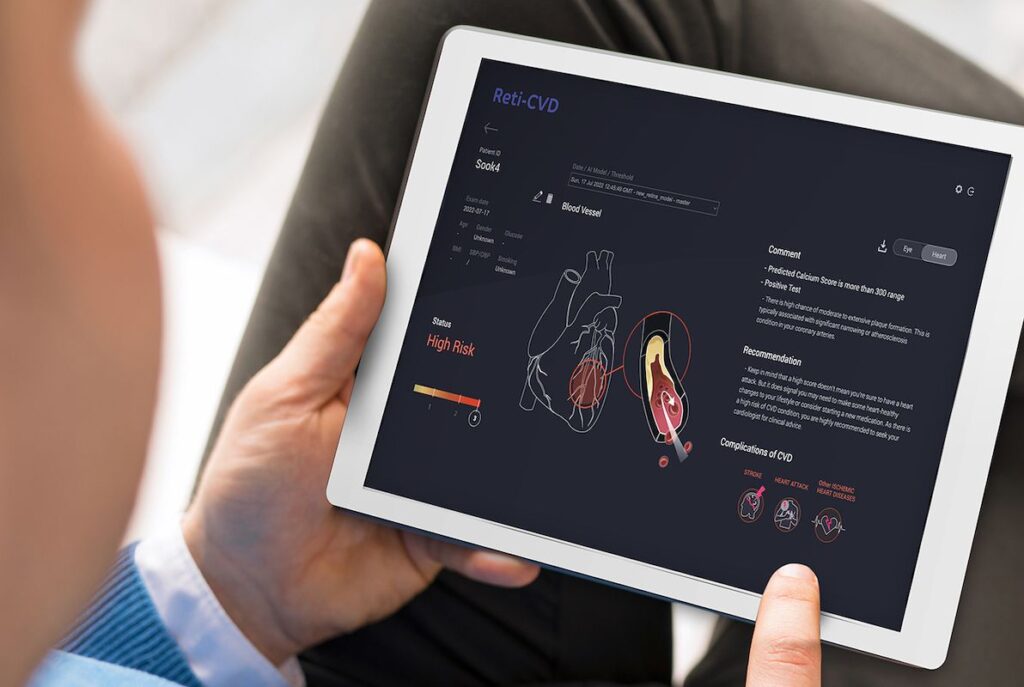
By synthesizing this information, the AI model can generate a quantitative risk score, estimating the likelihood that an individual will suffer a major cardiac event, such as a heart attack or stroke, within a given timeframe.
The Latest Research: A Leap Forward in Accuracy
Recent studies, including the work highlighted in the news, have moved this concept from promising theory to validated tool. In one major development, scientists have created AI models that can directly predict “left ventricular dysfunction” and “cardiovascular disease risk” from retinal photos alone.
The process is remarkably straightforward:
- A patient has their retina digitally photographed using a standard fundus camera—a device already in widespread use in eye clinics.
- The image is uploaded and analyzed by the AI algorithm in a matter of seconds.
- The system provides an assessment, flagging patients with high-risk features who should be referred to a cardiologist for further investigation.
Crucially, these models have demonstrated high accuracy, often matching or approaching the predictive power of more traditional, invasive, and expensive tests. This means a routine, minute-long procedure could one day serve as a powerful frontline screening tool.
The Transformative Potential for Preventative Healthcare
The implications of integrating AI-powered eye screening into routine care are profound.
1. Unprecedented Accessibility and Convenience: Heart disease screening often requires separate doctor’s appointments, blood tests, and sometimes advanced imaging. Embedding this risk assessment into an existing, common health check—the eye exam—removes significant barriers. People who may not regularly see a primary care physician often still visit an optometrist.
2. True Early Detection: The goal is to identify at-risk individuals in the “subclinical” phase, where preventative lifestyle changes and medications are most effective. Catching cardiovascular strain early, before irreversible damage occurs, is the holy grail of cardiology.
3. A Paradigm Shift in Optometry: Optometrists and ophthalmologists would transition into even more critical roles as frontline detectors of systemic disease. A routine checkup could yield vision prescriptions and life-saving health referrals simultaneously.
4. Cost-Effectiveness for Health Systems: Widespread, low-cost screening could reduce the enormous economic burden of treating advanced heart disease and stroke by shifting the focus to prevention.
Challenges and the Path Forward
Despite the excitement, there are important steps before this becomes standard practice.
- Clinical Trials & Regulation: Large-scale, prospective clinical trials are needed to confirm the AI’s effectiveness in diverse, real-world populations. Regulatory bodies like the FDA must review and approve these tools as medical devices.
- Data Diversity: AI models must be trained on datasets representing all ethnicities and backgrounds to ensure they are accurate and unbiased for everyone.
- Integration into Workflow: The technology must be seamlessly integrated into existing clinic software and workflows without slowing down practitioners.
- Ethical and Privacy Considerations: Clear protocols for handling sensitive health data and for communicating risk to patients are essential. Who tells the patient their result, and what is the recommended next step?
A Vision of the Future: Your Next Eye Exam
Imagine walking into your local optician for a regular checkup. Alongside testing your visual acuity, the clinician takes a detailed digital scan of your retinas. Within moments, the AI software provides a readout: not just about macular health or glaucoma risk, but an assessment of your cardiovascular system. For most, it will be a reassuring confirmation of low risk. For others, it will be an early, silent alert—a chance to take action with diet, exercise, and medical consultation long before a crisis strikes.
The research is clear: the eyes are more than a window to the soul; they are a high-definition mirror of our heart’s health. By empowering AI to decode the subtle language of the retinal vasculature, we are on the cusp of a preventative healthcare revolution. The future of heart disease screening may not be in a cardiologist’s office, but in the familiar chair of your eye doctor, offering a painless, powerful glimpse into your body’s most vital workings.