California’s Children Face a Growing Crisis in Vision Care Access
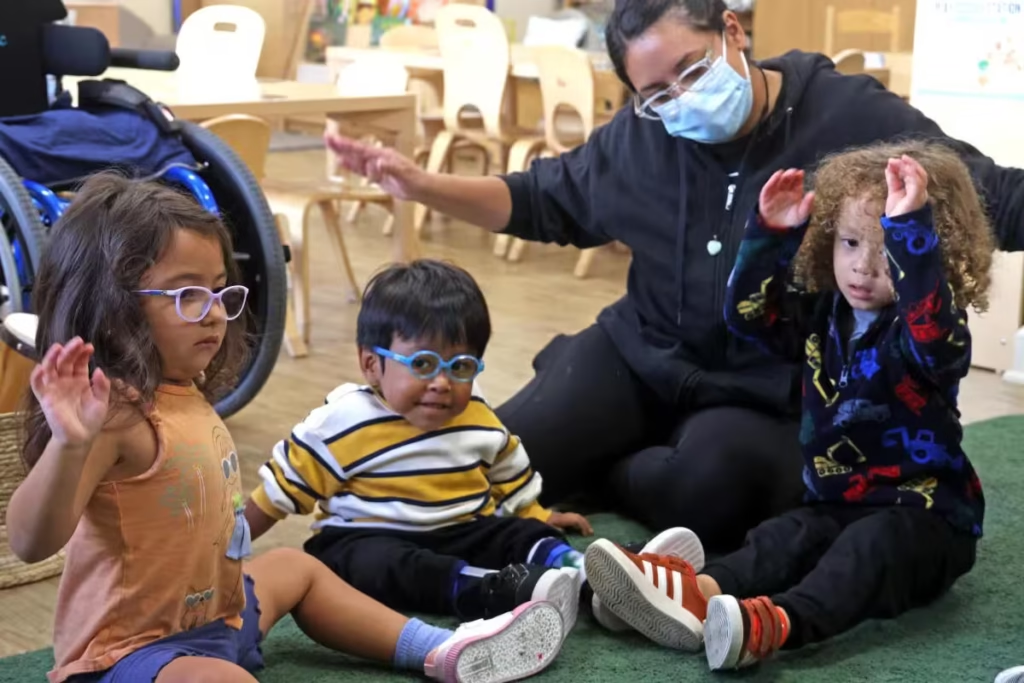
For over 1.5 million low-income children in California, seeing the world clearly—and succeeding in it—is becoming an uphill battle. These children rely on Medi-Cal, the state’s Medicaid program, for essential health services, including vision care. However, a systemic and growing crisis in access to eye exams and glasses is threatening their education, safety, and future.
The problem isn’t a lack of coverage. Medi-Cal benefits for children are robust on paper, including comprehensive vision services. The crisis lies in the severe shortage of providers willing to accept Medi-Cal patients, creating vast “vision care deserts” across the state. This access gap means that a routine eye exam, a critical check for a developing child, can require a months-long wait, a journey of hundreds of miles, or is simply never obtained.
The Stark Reality: Why Providers Are Turning Away
The core of the access crisis is a simple equation: low reimbursement rates and high administrative burdens make it financially unsustainable for many optometrists and ophthalmologists to see Medi-Cal patients.
Reimbursement rates for a child’s eye exam under Medi-Cal are often less than half of what private insurance pays, and sometimes even lower than the actual cost of providing the service. For a small practice, seeing a significant number of Medi-Cal patients can mean operating at a loss. Compounding this is the notorious complexity of Medi-Cal’s billing and authorization systems, which can delay payments for months and require hours of staff time to navigate.
As a result, the network of willing providers has shrunk dramatically. In many counties, especially rural ones, families might find only one or two vision providers in the entire region who accept Medi-Cal, if any at all. Urban areas aren’t immune either, with long wait lists becoming the norm. This bottleneck leaves parents with an impossible choice: pay out-of-pocket for care they are entitled to, or let their child’s vision problems go unaddressed.
The High Cost of Uncorrected Vision
When a child cannot see clearly, the consequences extend far beyond blurry whiteboards. Uncorrected vision problems directly and profoundly impact a child’s life:
- Academic Struggles: An estimated 80% of learning is visual. Children who can’t see the board, read a book, or focus on a computer screen are immediately at a disadvantage. They may be mislabeled as having a learning disability or behavioral issues, when the root cause is simply poor eyesight.
- Developmental Delays: Vision is critical for motor skill development, social interaction, and overall cognitive growth. Conditions like amblyopia (lazy eye) must be treated early in childhood, or the window for effective treatment closes permanently.
- Safety Risks: Poor depth perception and clarity can make playground activities, sports, and even crossing the street more dangerous.
- Long-Term Inequality: Starting life with an untreated disability creates a ripple effect. Educational setbacks can limit future opportunities, perpetuating cycles of poverty and poor health.
The Human Impact: Stories from the Frontlines
Behind the statistics are real families facing immense hardship. Consider the single mother in the Central Valley who took three different buses over four hours for her son’s eye appointment, only to be told the glasses he was prescribed would take another 8-12 weeks to arrive. Or the parent in a rural northern county who drove 120 miles to the nearest in-network provider, missing a day of work and paying for gas they could scarcely afford.
School nurses and teachers have become de facto first responders in this crisis. They often are the ones to first notice a child squinting, holding books too close, or complaining of headaches. Yet, when they refer a family for care, they hit the same wall: no appointments, no providers, insurmountable delays. Schools are left trying to fill the gap with limited vision screening programs and charitable clinics, but these are stopgap measures, not a solution to a broken system.
Pathways to a Clearer Future: Potential Solutions
Addressing this crisis requires concerted action from state policymakers, healthcare administrators, and provider groups. The goal must be to make participating in Medi-Cal a viable choice for eye care professionals. Several solutions are on the table:
1. Increase Reimbursement Rates to Sustainable Levels
This is the most direct and frequently cited solution. Aligning Medi-Cal vision service rates closer to Medicare or commercial insurance levels would immediately make it more feasible for providers to accept these patients. An investment in prevention here saves money in the long run on special education services, untreated eye disease, and lost productivity.
2. Streamline Billing and Reduce Administrative Burden
Simplifying the claims process, ensuring timely payments, and reducing prior authorization hurdles would remove a major point of frustration for providers. A more efficient system lowers overhead costs and makes participating less of an administrative nightmare.
3. Expand Innovative Care Models
Thinking outside the traditional office visit can help. This includes:
- Investing in school-based vision programs that bring optometrists and mobile clinics directly to campuses.
- Utilizing telehealth for follow-ups and certain consultations to reduce travel burdens for rural families.
- Supporting community health centers to integrate vision care into their primary care offerings.
4. Boost Provider Recruitment and Education
Creating incentives for new optometry graduates to practice in underserved areas and ensuring they are educated on the Medi-Cal system could help build the provider pipeline. Loan forgiveness programs tied to serving Medi-Cal patients in high-need regions could be a powerful tool.
A Moral and Economic Imperative
Ensuring that California’s children can see is not a niche healthcare issue; it is a fundamental matter of equity, education, and public health. Clear vision is a prerequisite for learning, and learning is the foundation of a successful life. When we fail to provide basic vision care to 1.5 million children, we are dimming the future potential of our state.
The vision care access crisis is a solvable problem. It requires acknowledging that the current system is failing our most vulnerable children and mustering the political will to fix it. By adequately funding and streamlining Medi-Cal vision services, California can clear the path for every child to see the board, read a book, and envision a brighter future. The time for action is now, before another generation falls behind.