One Surat Doctor’s 18-Year Mission: 21,000 Free Surgeries Fighting Blindness
In the diamond-driven city of Surat, where industry and commerce define daily life, one doctor has been quietly fighting a different kind of battle—preventable blindness.
For nearly two decades, Dr. Bhavin Patel has not just treated patients. He has restored sight, dignity, and economic independence to more than 21,000 people who otherwise would have lived in darkness.
This is not a story of symbolic charity. It is a story of surgical discipline, logistical precision, and a belief that vision is a basic human right—not a privilege.
The Rural Blindness Crisis: A Numbers Problem Most Doctors Avoid
India accounts for nearly 20% of the world’s blind population. According to the World Health Organization, over 8 million people in India are blind, and around 80% of these cases are preventable or treatable.
The most common cause is untreated cataract—a condition that can be corrected with a short 15-minute surgery costing around ₹2,000 in public systems.
But for millions in rural Gujarat—from Kutch to the tribal regions of Dang—that cost, combined with travel and fear, becomes an impossible barrier.
Dr. Patel identified three core obstacles:
- Distance
- Cost
- Fear
Together, they create a cycle of neglect. A blind farmer loses productivity. A visually impaired elder becomes dependent. Over time, untreated cataracts deepen poverty and isolation.
Dr. Bhavin Patel: Bringing Surgery to the Villages
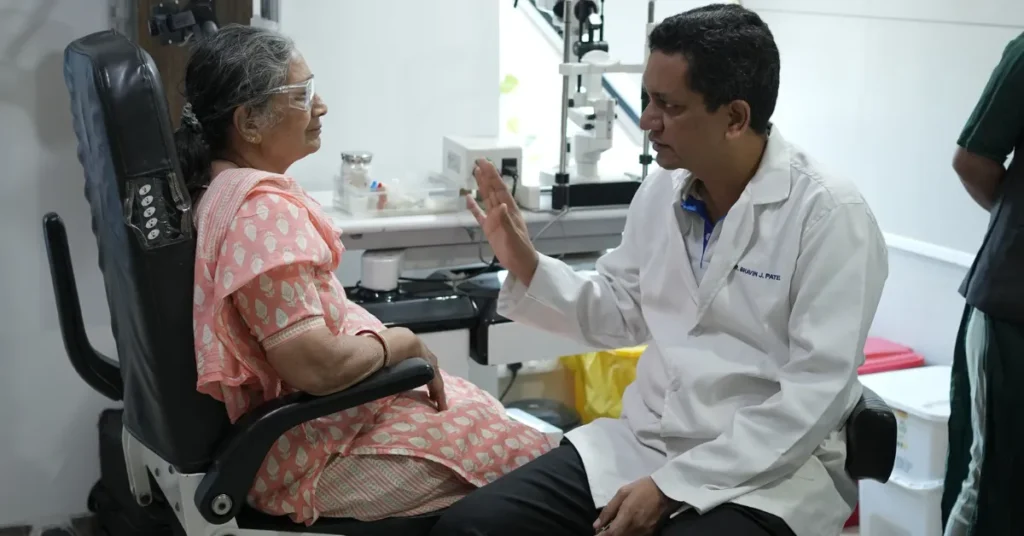
Dr. Bhavin Patel is a senior ophthalmologist at JK Hospital and Research Centre in Surat. Rather than waiting for patients to come to him, he brought medical care to them.
In 2006, he launched the “Dr. Beyond Sight” rural outreach program, a mobile ophthalmology initiative designed to reach underserved communities.
How the Model Works
- Village screening camps identify patients with cataract, glaucoma, and retinal diseases
- Selected patients are transported to JK Hospital in Surat
- Surgeries are performed using modern techniques, often allowing same-day discharge
- Post-operative care is continued in the villages through follow-up visits
This system functions like a medical supply chain—moving patients efficiently through diagnosis, treatment, and recovery.
The program has conducted over 1,000 screening camps across Gujarat, including Navsari, Valsad, Tapi, and Narmada.
The Scale: 21,000 Surgeries in Perspective
The number 21,000 is not symbolic—it reflects sustained surgical output over 18 years.
That averages:
- Around 1,167 surgeries per year
- Roughly 3 surgeries per day
Each case represents a patient who transitioned from severe vision impairment to functional sight—often regaining near-normal vision within hours of surgery.
Funding comes from multiple sources:
- CSR contributions from Surat’s diamond and textile industries
- Support from Rotary and Lions Clubs
- Personal financial input from Dr. Patel himself
One case remains particularly memorable: a 72-year-old farmer who had been blind for four years. After surgery, he reportedly said, “I can see my grandson’s face for the first time.”
High-Quality Surgery Without the Price Barrier
Despite being free for patients, the surgical standards are comparable to top-tier private hospitals.
Procedures use:
- Phacoemulsification (no-stitch cataract surgery)
- Foldable intraocular lenses (IOLs)
- Sterile, hospital-grade operating protocols
Each patient undergoes:
- Pre-surgical eye measurements
- Topical anesthesia for safety
- Antibiotic protection to prevent infection
- Same-day discharge with clear aftercare instructions
Patients also receive medication, protective eyewear, and emergency contact access for follow-up care.
Expanding Beyond Cataract: Glaucoma and Diabetic Blindness
As the program matured, it expanded beyond cataract surgery into more complex eye conditions.
In diabetes-affected regions of Gujarat, the team now performs:
- Retinal screening using portable imaging devices
- Laser treatment for diabetic retinopathy
- Anti-VEGF injections for advanced retinal disease
These procedures are significantly more expensive, but partnerships with pharmaceutical companies and cross-subsidization models help maintain affordability.
The Economic Impact of Restoring Sight
Blindness is not only a medical issue—it is an economic one.
A visually impaired adult in a rural household can reduce family income by 30–50%, as another member often becomes a full-time caregiver.
Restoring vision changes this dynamic completely:
- Farmers return to work
- Weavers resume production
- Elders regain independence
- Families recover lost income
The World Bank classifies cataract surgery as one of the most cost-effective medical interventions globally, delivering returns many times over the initial investment.
Dr. Patel’s 21,000 surgeries have therefore created a significant economic ripple effect across rural Gujarat.
Operational Challenges on the Ground
Despite its success, the program faces ongoing structural challenges.
Key difficulties include:
- Poor rural transportation infrastructure, especially during monsoons
- Patient hesitation due to superstition or fear of surgery
- Unstable funding tied to CSR cycles and economic conditions
At times, patients are transported using tractors or bullock carts when roads are inaccessible.
Community trust-building is also critical. Local volunteers—often former patients—help educate and reassure new candidates for surgery.
Building a Scalable Model
Dr. Patel’s approach is designed for replication.
Key principles include:
- Partnering with existing hospitals instead of building new facilities
- Using mobile screening units for early detection
- Training local health workers for continuity of care
- Tracking surgical outcomes and transparency in reporting
This system turns ophthalmology into a scalable public health model rather than isolated charity work.
Looking Ahead: A 50,000-Surgery Goal
Dr. Bhavin Patel, now in his late 40s, has no intention of slowing down. His next target is 50,000 surgeries by 2035.
New initiatives include tele-ophthalmology kiosks, where village-level operators can send eye scans directly to specialists in Surat for diagnosis.
His guiding belief remains unchanged:
“Every person we don’t reach is a life unnecessarily lost to darkness.”
Final Perspective
In an era where healthcare is often defined by corporate systems and high-cost innovation, Dr. Bhavin Patel’s work is a reminder of something more fundamental.
Medicine, at its core, is not just treatment—it is access.
Through 18 years of consistent effort, over 21,000 lives have moved from blindness to sight. And in doing so, one doctor has quietly demonstrated that large-scale impact is possible when systems are built with precision, compassion, and persistence.