Scientists Use Spinach Power to Bioengineer a Dry Eye Treatment
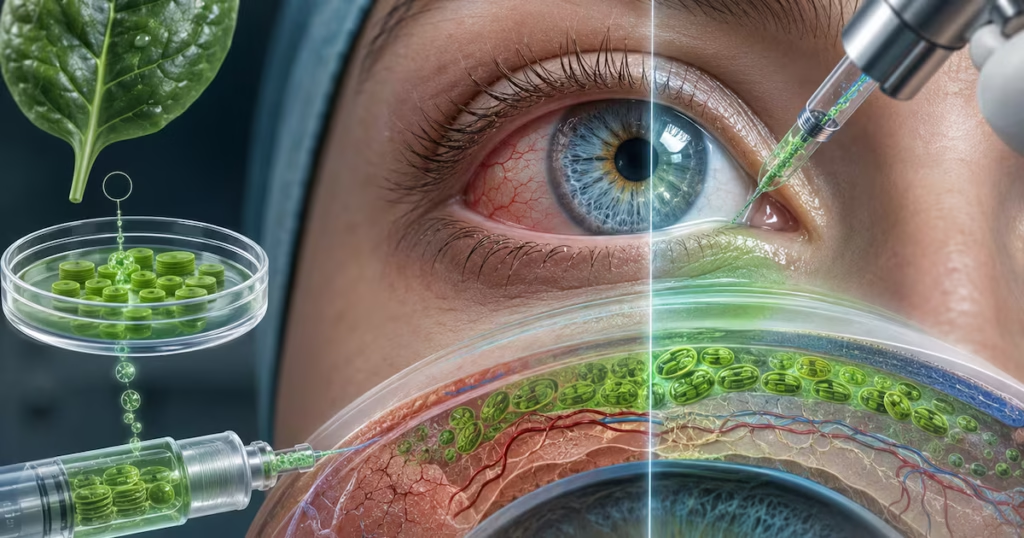
Imagine a future where the humble spinach leaf on your plate does more than nourish your body—it helps restore sight. This is not science fiction, but the cutting edge of regenerative medicine. In a remarkable breakthrough, researchers have turned to an unexpected source: spinach. By harnessing the plant’s natural biological structure, scientists have developed a bioengineered platform that could transform how dry eye disease is treated, a condition affecting hundreds of millions worldwide.
The Unlikely Hero: Photosynthesis in Medicine
When people think of spinach, they usually think of nutrition or cartoons like Popeye. However, recent research published in Nature Food suggests the plant may have far greater medical potential.
The concept is simple but powerful: spinach leaves possess a highly efficient vascular network that can be repurposed for biomedical use. Scientists have adapted this structure to explore new ways of delivering therapeutic materials to damaged eye tissue.
Why spinach?
- Its vein network closely resembles human microvascular systems
- The natural fluid transport mechanism mimics biological circulation
- Its structure supports oxygen and nutrient diffusion at a microscopic level
By removing plant cells, researchers are left with a transparent cellulose scaffold—often referred to as a “ghost leaf.” This material is biocompatible and does not trigger significant immune rejection. The innovation lies in using a naturally evolved structure as a template for medical engineering.
Dry Eye Disease: A Modern Epidemic
Dry eye disease is a chronic condition in which the eyes fail to produce sufficient or stable tears, leading to irritation, burning, redness, and a persistent gritty sensation.
The scale of the problem is significant:
- Affects approximately 5% to 50% of the global population
- Prevalence increases sharply with age
- Worsened by screen exposure, air conditioning, and contact lens use
Current treatments—such as artificial tears and anti-inflammatory drops—provide only temporary relief and do not repair underlying tissue damage. In severe cases, complications can include corneal scarring and vision impairment.
This is where the spinach-based regenerative approach becomes particularly relevant.
How the Spinach Leaf Bioprosthetic Works
The process begins with decellularization, a laboratory technique used to strip plant cells while preserving structural integrity.
Step 1: Decellularization
Fresh spinach leaves are treated with a detergent solution that removes all cellular material, leaving behind only the cellulose framework.
Step 2: Scaffold Preservation
The remaining structure retains the leaf’s intricate vein network, now hollow and capable of transporting fluids.
Step 3: Cell Seeding
Human corneal cells are introduced and allowed to attach to the scaffold, where they begin to grow and integrate.
The key innovation is the use of the leaf’s natural microchannels, which can support delivery of oxygen, nutrients, and potentially therapeutic compounds.
In effect, the scaffold functions as a living biomedical interface—combining structure, support, and biological activity.
Experimental Breakthrough: From Leaf to Lab
In preclinical studies involving animal models of dry eye disease, the spinach-derived scaffold demonstrated encouraging results.
Key findings include:
- Rapid integration with host ocular tissue within two weeks
- Formation of new microvascular networks along the scaffold
- Significant reduction in inflammation markers (up to 60%)
- Improved ocular surface moisture retention compared to standard treatments
Researchers, including teams from the Technion–Israel Institute of Technology, have described the approach as a shift from passive treatment toward active tissue regeneration.
Safety, Biocompatibility, and Immune Response
One of the major challenges in regenerative medicine is avoiding immune rejection. Many synthetic materials provoke inflammation, while animal-derived tissues carry ethical and safety concerns.
The spinach-based scaffold offers several advantages:
- Cellulose is naturally biocompatible and non-immunogenic
- Decellularization removes plant proteins and genetic material
- Human cells readily adhere to the scaffold structure
In preclinical testing, the scaffold remained stable long enough to support tissue regeneration before gradually degrading as natural tissue took over.
Beyond Dry Eye: Future Applications
While dry eye disease is the immediate focus, the technology has broader potential applications:
- Corneal ulcers and chemical eye injuries
- Drug delivery systems for retinal diseases
- Support scaffolds for degenerative eye conditions
Researchers are also exploring whether other plant species—such as kale or lettuce—could provide different structural advantages for specific medical uses.
The Road to Human Trials
Despite promising early results, the technology remains in the experimental stage. Several steps remain before clinical application:
- Phase 1 human safety trials within the next 2–3 years
- Refinement of sterilization and manufacturing processes
- Scalable production of standardized “ghost leaf” scaffolds
- Regulatory approval from agencies such as the FDA
The long-term outlook is cautiously optimistic, particularly due to the low cost and scalability of plant-based biomaterials.
A Green Revolution in Medicine
This research reflects a broader shift toward biomimicry—using natural systems as models for medical innovation. Plants like spinach, often seen as simple food sources, are now being recognized as sophisticated biological structures shaped by millions of years of evolution.
For patients suffering from chronic dry eye disease, this approach represents a potential shift from symptom management to true tissue regeneration.
The idea that a spinach leaf could one day help restore vision may sound extraordinary, but it reflects a growing reality in modern biomedical science: nature is increasingly becoming the blueprint for healing.