How Blood Pressure May Affect Pressure Inside the Eyes
High blood pressure often develops without noticeable symptoms, which is why regular health checks are important even when you feel well. Eye pressure can also rise without causing obvious discomfort, making it possible for changes to go unnoticed until an eye examination reveals a problem.
Researchers studying Canadian adults have found evidence connecting these two measurements. Their findings suggest that higher blood pressure may contribute to increased intraocular pressure (IOP), the pressure exerted by fluid inside the eye. However, the evidence for a direct cause-and-effect relationship is not conclusive.
The research, published in Frontiers in Genetics in 2026, examined blood pressure and intraocular pressure using information from the Canadian Longitudinal Study on Aging (CLSA). The investigators combined conventional statistical analysis with genetic methods to investigate whether elevated blood pressure might actually contribute to higher eye pressure.
What the Canadian Study Discovered
The researchers analyzed data from 21,633 adults aged 45 to 85. Participants were drawn from the Canadian Longitudinal Study on Aging, which recruited community-dwelling adults from seven Canadian provinces between 2010 and 2015.
For the main individual-level analyses, the team restricted the sample to unrelated participants of European descent who had complete blood pressure and eye pressure measurements. This restriction helped address potential genetic differences within the study population, although it also limits how confidently the findings can be applied to people of other ancestries.
The researchers examined three blood pressure measurements: systolic pressure, diastolic pressure, and pulse pressure. Systolic pressure represents the force against artery walls when the heart contracts, while diastolic pressure measures the force when the heart relaxes between beats. Pulse pressure is the difference between systolic and diastolic readings.
The observational analysis found that all three measurements were positively associated with intraocular pressure. The researchers adjusted their statistical models for factors including age, sex, education, income, diabetes, smoking, alcohol consumption, body mass index, and blood lipid levels.
How Much Did Eye Pressure Increase?
The results included specific estimates for the relationship between blood pressure and eye pressure. For every 10 mmHg increase in systolic blood pressure, intraocular pressure was approximately 0.22 mmHg higher.
The association was larger for diastolic blood pressure, with an estimated 0.37 mmHg increase in eye pressure per 10 mmHg increase in diastolic pressure. For pulse pressure, the corresponding increase was approximately 0.20 mmHg per 10 mmHg.
These figures describe statistical associations across the study population. They do not mean that every individual will experience the same change in eye pressure when their blood pressure rises. Nor do they establish that blood pressure alone explains why a person’s eye pressure is elevated.
The researchers also compared their results with an earlier meta-analysis, which reported an average increase of 0.26 mmHg in eye pressure for every 10 mmHg increase in systolic blood pressure. The broadly similar findings provide additional context for the observed relationship.
Why Researchers Used Genetic Analysis
Observational research can identify relationships between health measurements, but it cannot always determine which factor causes the other. Blood pressure and eye pressure may be associated because of other biological processes, shared risk factors, or a combination of influences.
To investigate this issue, the research team used a method called Mendelian randomization. This approach uses genetic variants associated with a particular exposure, such as blood pressure, to estimate whether that exposure may influence an outcome, such as intraocular pressure.
The researchers conducted one-sample and two-sample Mendelian randomization analyses. The first approach examined genetic information within the Canadian study population. The second combined blood pressure genetic associations from a much larger external analysis, involving up to approximately one million people of European descent, with eye pressure information from the Canadian cohort.
In the one-sample analysis, genetically predicted systolic blood pressure was associated with higher intraocular pressure. The estimated change was 0.227 mmHg in eye pressure for every 10 mmHg increase in systolic blood pressure. The 95% confidence interval ranged from 0.074 to 0.381 mmHg, with a P value of 0.004.
However, the same analysis did not find statistically significant evidence that genetically predicted diastolic pressure or pulse pressure caused changes in eye pressure. The distinction matters because the observational associations involving all three measurements did not translate into equally strong evidence of a causal effect for each one.
Did the Other Genetic Tests Confirm the Findings?
The two-sample analyses also provided evidence that higher systolic blood pressure may increase intraocular pressure. Using the inverse-variance weighted random-effects method, the researchers estimated an increase of 0.216 mmHg in eye pressure per 10 mmHg increase in systolic blood pressure.
The 95% confidence interval for this estimate was 0.043 to 0.390 mmHg, with a P value of 0.015. Two additional methods supported a positive association: the contamination mixture method estimated 0.314 mmHg, while MR-PRESSO estimated 0.239 mmHg per 10 mmHg increase in systolic pressure.
Nevertheless, the genetic evidence had limitations. An MR-Egger intercept test indicated possible directional pleiotropy, meaning some genetic variants might affect eye pressure through biological pathways other than blood pressure. This can complicate the interpretation of Mendelian randomization results.
When the researchers used an additional technique called Steiger filtering to assess the direction of genetic effects, the main one-sample systolic finding did not remain supported, although some two-sample evidence persisted. These inconsistencies mean the results should be treated as suggestive rather than definitive proof of causation.
What About Genetic Risk for Glaucoma?
The researchers also investigated whether inherited susceptibility to elevated eye pressure changed the relationship between blood pressure and intraocular pressure.
They created a polygenic risk score based on 122 genetic variants previously associated with intraocular pressure in a genome-wide association study involving 139,555 people of European ancestry. This score provided a way to estimate participants’ inherited tendency toward higher eye pressure.
The analysis found no clear evidence that the genetic risk score altered the association between blood pressure and eye pressure. Interaction P values were at least 0.122, indicating that the study did not identify a statistically significant modifying effect.
This does not mean genetics are irrelevant to glaucoma or eye pressure. Instead, the findings suggest that the observed relationship between blood pressure and eye pressure was not demonstrably different according to this particular genetic risk score.
Why Eye Pressure Matters for Glaucoma
Intraocular pressure reflects the balance between the production and drainage of aqueous humor, the clear fluid that circulates inside the front portion of the eye. When this balance changes, pressure can rise.
One possible explanation for the research findings is that higher systemic blood pressure could influence aqueous humor production or the drainage pathways. Changes in episcleral venous pressure, which affects fluid outflow from the eye, may also play a role. These are potential biological explanations, not mechanisms proven by this study.
Elevated intraocular pressure is an important modifiable risk factor for glaucoma, a group of eye diseases that damage the optic nerve. Glaucoma can progress gradually, and many people experience no early warning symptoms. If damage advances, it can cause permanent vision loss.
However, elevated eye pressure does not automatically mean someone has glaucoma, and glaucoma can develop in people whose measured eye pressure falls within the usual range. The relationship between systemic blood pressure and glaucoma risk is also complicated. Both unusually high and low blood pressure have been associated with glaucoma in some research, potentially because blood supply to the optic nerve matters alongside pressure inside the eye.
How Doctors Measure Eye Pressure
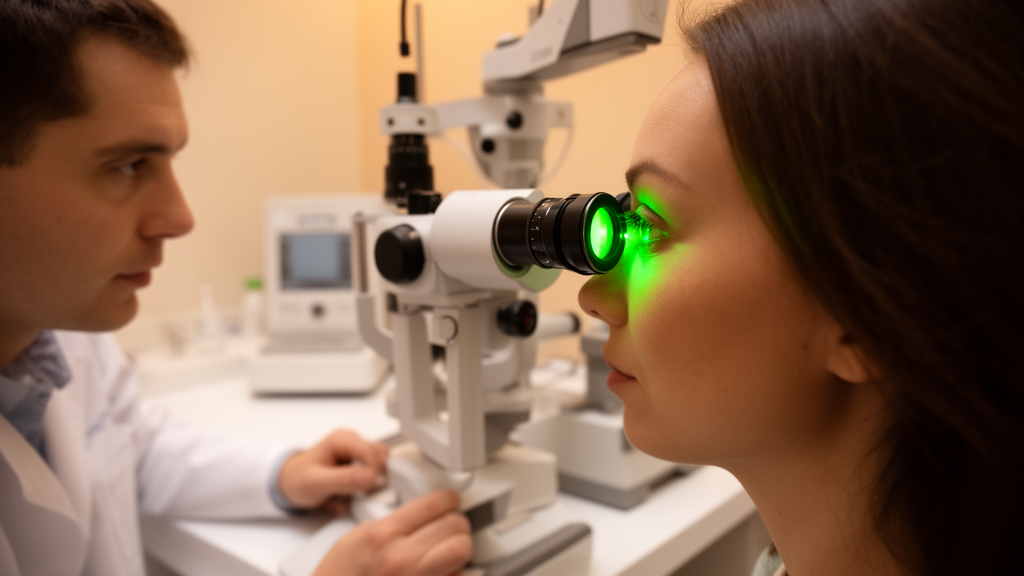
Eye care professionals commonly use tonometry to measure intraocular pressure. Depending on the equipment, this may involve a gentle puff of air or a small instrument that measures pressure at the surface of the eye after appropriate preparation.
In the Canadian study, eye pressure was measured using an ocular response analyzer, and the average corneal-compensated measurement from both eyes was used in the analysis. Blood pressure was measured six times with an automated monitor. The first reading was discarded, and the remaining five readings were averaged.
When glaucoma is suspected, an eye examination may also include an assessment of the optic nerve, visual field testing, and gonioscopy. Gonioscopy allows the clinician to examine the drainage angle inside the eye and determine whether it is open or narrowed.
These tests provide different pieces of information. A blood pressure reading cannot substitute for an eye examination, and an eye pressure measurement alone cannot confirm or exclude every form of glaucoma.
When Should You See a Doctor?
Arrange a routine eye examination if you have concerns about glaucoma, have a family history of the disease, or have been told that your eye pressure is elevated. Regular screening is particularly important because early glaucoma may not cause pain, blurred vision, or other noticeable symptoms.
Seek urgent medical attention if you develop sudden severe eye pain, a red eye, blurred vision, halos around lights, or a severe headache accompanied by nausea or vomiting. These symptoms can indicate acute angle-closure glaucoma or another eye emergency and should not be ignored.
If you have high blood pressure, continue to have it monitored and managed with guidance from your healthcare professional. Do not change prescribed treatment based on this study alone. The research does not establish that lowering blood pressure will necessarily lower eye pressure or prevent glaucoma.
What the Findings Mean for Your Eye Health
The Canadian research adds evidence that blood pressure and intraocular pressure are connected, with genetic analyses offering some support for a possible causal effect of systolic blood pressure. Yet the mixed results, potential genetic-method limitations, and restricted study population leave important questions unanswered.
Further research involving more diverse populations and additional independent analyses will be needed to clarify whether managing blood pressure can directly influence eye pressure or glaucoma outcomes.
For now, a practical next step is to keep up with routine blood pressure checks and schedule comprehensive eye examinations at intervals recommended by your eye care professional. Managing cardiovascular health and monitoring vision are complementary ways to protect your long-term well-being.
Research source: Bastasic J, Rakesh M, Freeman EE, Little J, Burkett KM, and Roy-Gagnon M-H. “Blood pressure and intraocular pressure in the Canadian Longitudinal Study on Aging: a bidirectional Mendelian randomization analysis.” Frontiers in Genetics, 2026;17:1967280. https://doi.org/10.3389/fgene.2026.1967280.