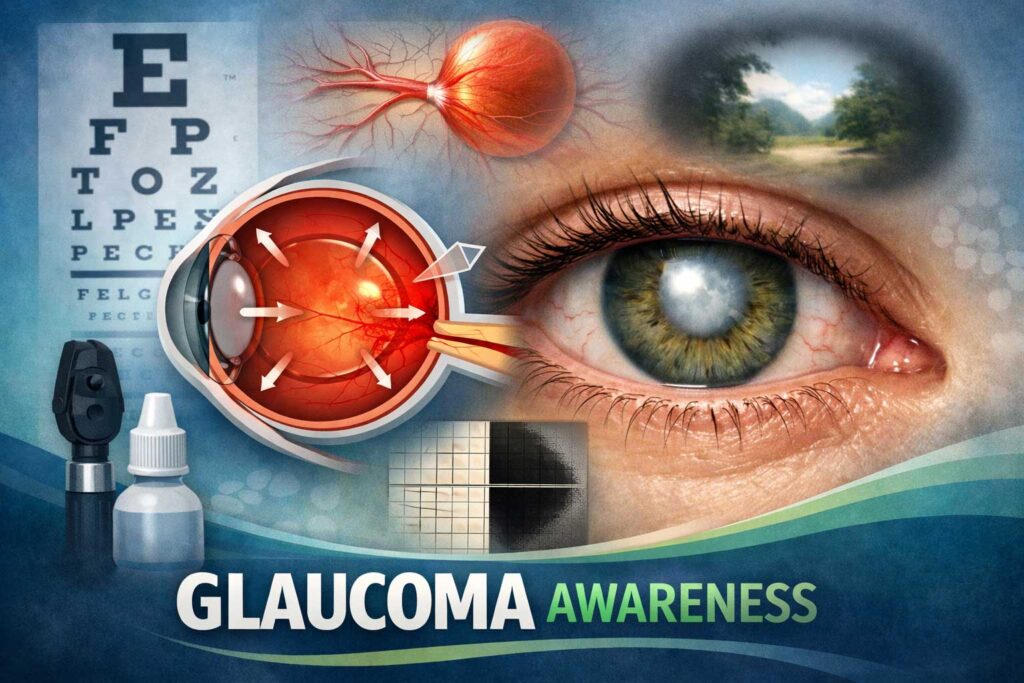
Have you ever wondered what happens to your eyes under pressure?
What if the tissues inside your eye could feel force—and react?
This is the focus of mechanobiology in the eye.
Let’s break it down.
What Is Mechanobiology?
It’s the study of how cells respond to physical force.
Not chemicals. Not genes.
Just pressure, stretch, or stiffness.
Your eye is full of soft tissue.
Pressure inside the eye affects it all.
When pressure rises or tissues stiffen, your eye cells notice.
Then they respond.
Sometimes in ways that protect.
Other times in ways that damage.
Where It Happens in the Eye
Mechanobiology plays a role in many eye parts:
Cornea – reacts to touch and swelling
Lens – shifts shape during focus
Retina – senses changes in eye shape
Optic nerve head – vulnerable to high pressure
Trabecular meshwork – manages fluid outflow
Each part has its own way of reacting to mechanical stress.
Why It Matters for Glaucoma
Glaucoma is linked to pressure.
When intraocular pressure (IOP) stays high, it damages the optic nerve.
But not everyone with high pressure loses vision.
So what’s the missing piece?
Cell response.
Some people’s cells react to pressure in harmful ways.
Others adapt better.
Studying mechanobiology may help explain this.
How Cells Detect Force
Cells don’t just float around.
They attach to nearby tissue.
This lets them sense when something stretches or stiffens.
They use special proteins like:
Integrins
Ion channels
Cytoskeletal fibers
These help the cell feel force—and signal back.
It’s like the cell says, “Something changed. I need to react.”
What Happens After
Once a cell detects pressure, it may:
Release proteins
Trigger inflammation
Change its shape
Adjust how it sticks to nearby tissue
Die if stress is too much
All of this can affect eye health.
In glaucoma, for example, optic nerve cells under too much force may die early.
That leads to vision loss.
Real-Life Example: The Optic Nerve Head
This is where the nerve exits the eye.
It’s a weak spot—no bones, no thick tissue.
When pressure rises, this area stretches.
Cells here try to hold things together.
But they may get damaged in the process.
Understanding how they respond could improve glaucoma care.
What if we could help these cells resist pressure?
What Researchers Are Doing
Labs are now:
Growing eye cells on stretchable surfaces
Adding pressure to cells in dishes
Imaging eye tissue under load
Testing pressure responses in mice and primates
They look for genes and proteins involved in pressure sensing.
They test drugs that may change how cells respond.
Possible Future Treatments
Instead of just lowering pressure, doctors may one day:
Strengthen tissues that hold up under stress
Block harmful signals triggered by force
Support cell survival under pressure
This could slow down diseases like glaucoma
Even in patients with “normal” pressure levels.
Questions to Think About
Why do some people develop glaucoma with low pressure?
How can cells “remember” past stress?
Can we retrain them to resist damage?
These are questions mechanobiology might answer.
How It Affects You
If you’re at risk for eye diseases, pressure isn’t the only factor.
How your eye cells respond matters too.
Ask your doctor:
Is my optic nerve head healthy?
How does my eye tissue react to pressure over time?
Are there new therapies beyond pressure control?
Staying curious helps you stay ahead.
Final Thought
Your eyes are more than light sensors.
They are mechanical systems.
They bend, stretch, and feel pressure every day.
How they handle that force could decide how long you see clearly.
Now you know why that matters.