When Lung Cancer Reaches the Eye: Managing Neovascular Glaucoma From Choroidal Metastasis
Most people associate lung cancer with breathing difficulties or chest pain. Eye involvement rarely enters the conversation until it already becomes a problem.
When lung adenocarcinoma spreads to the choroid — the vascular layer behind the retina — it can trigger a cascade that ends in neovascular glaucoma (NVG). At that point, you’re no longer dealing with just a systemic cancer. You’re managing painful, vision-threatening eye disease on top of an advanced malignancy.
This creates a genuine clinical challenge. How do you treat the eye when the body is already fighting on multiple fronts?
What Is Choroidal Metastasis and Why Does It Happen?
The choroid receives roughly 85% of the eye’s blood supply. That makes it a common landing site for circulating tumor cells. Lung cancer — specifically adenocarcinoma — is one of the most frequent causes of choroidal metastasis.
Key facts about choroidal metastasis from lung cancer:
- It represents the most common intraocular tumor in adults
- Lung cancer accounts for a significant portion of all choroidal metastasis cases
- The lesion is often the first visible sign that lung cancer has spread
- Blurred vision, photopsia, and subretinal fluid are common presenting symptoms
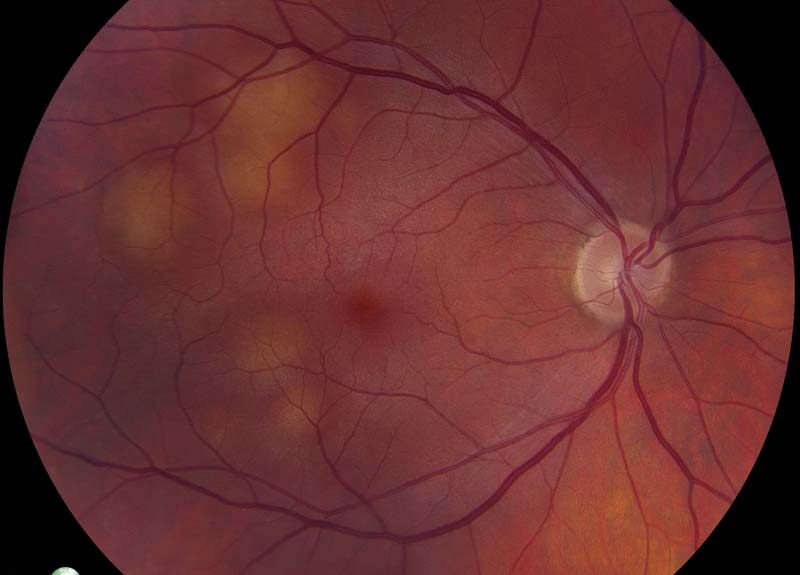
A 59-year-old woman reported in Retina Today presented with sudden-onset blurry vision and photopsia in her right eye. Her visual acuity had dropped to 20/200. She was already undergoing evaluation for a lung mass when the eye findings pointed directly to metastatic disease. The choroidal lesion became the clinical clue that unlocked the diagnosis.
How Does Neovascular Glaucoma Develop?
Neovascular glaucoma is a secondary form of glaucoma. It doesn’t start in the drainage structures of the eye. It starts with abnormal blood vessel growth — neovascularization — driven by VEGF (vascular endothelial growth factor).
When a choroidal metastasis disrupts normal retinal blood flow, the eye responds by producing excess VEGF. New, fragile blood vessels grow across the iris and into the drainage angle. Over time, they block aqueous outflow and intraocular pressure (IOP) rises sharply.
The result:
- Severe eye pain
- Elevated IOP that resists standard treatment
- Accelerated vision loss
- A compromised quality of life during an already difficult period
For patients already navigating stage IV lung cancer, this level of ocular pain can significantly reduce daily function and wellbeing.
The Palliative Management Problem
Here’s the clinical reality: most patients with choroidal metastasis from lung adenocarcinoma present at an advanced disease stage. Curative intent is often off the table. The goal shifts to symptom control, pain relief, and preserving whatever function remains.
That creates a layered management challenge.
Managing neovascular glaucoma in this context involves:
- Anti-VEGF injections (such as ranibizumab or bevacizumab) to suppress neovascularization
- Topical and oral IOP-lowering agents to reduce pressure
- Transscleral cyclophotocoagulation to decrease aqueous production
- External beam radiotherapy targeting the choroidal lesion
- Enucleation as a last resort when pain control fails all other options
A 2023 case report in Archivos de la Sociedad Española de Oftalmología documented intravitreal ranibizumab used as palliative treatment for refractory NVG caused by iris metastasis from small-cell lung cancer. The injection reduced iris neovascularization and relieved pain — a meaningful outcome for a patient with limited survival.
Why Anti-VEGF Therapy Matters Here
VEGF drives both the choroidal lesion’s vascularity and the secondary glaucoma. Targeting it systemically or intravitreally addresses both problems at once.
A case published in a Hindawi journal showed complete regression of a choroidal metastasis from lung adenocarcinoma after four cycles of docetaxel, cisplatinum, and systemic bevacizumab at 10 mg/kg every three weeks. The subretinal fluid resolved fully. Lung primary cancer also decreased in size.
This raises a practical question: should anti-VEGF agents be considered earlier in patients with choroidal metastasis, before NVG develops?
The answer likely depends on:
- Performance status and fitness for systemic chemotherapy
- Whether the patient has EGFR or ALK mutations that respond to targeted therapy
- The pace of IOP elevation and the degree of angle involvement
- Patient goals — whether they prioritize vision preservation or purely pain control
What Clinicians Should Watch For
If you’re managing a patient with known or suspected lung adenocarcinoma, any new visual complaint warrants urgent ophthalmologic referral.
Watch for:
- Unilateral blurred vision or photopsia
- Red, painful eye with elevated IOP
- Iris neovascularization on slit-lamp examination
- Asymmetric visual field loss
A patient who declines systemic treatment faces a different trajectory. One case report on PubMed described a patient with stage IV lung adenocarcinoma who declined palliative chemotherapy and opted for supportive care. Her vision deteriorated to counting fingers. She then developed phacomorphic glaucoma that led to blindness in the affected eye despite IOP management attempts.
That outcome is preventable in some cases. Early identification changes what options remain available.
Shared Decision-Making: The Overlooked Step
The median survival for patients with choroidal metastasis and NVG from lung cancer is short. Some data places survival for iris metastasis patients at around four months.
That context matters when you’re deciding between aggressive ocular intervention and comfort-focused care.
The clinical decision is not just technical. It involves:
- What the patient defines as quality of life
- Whether pain control alone is sufficient
- Whether preserving sight in one eye changes their daily experience
- The burden of additional procedures during systemic treatment
Ask your patient directly: what does vision mean to you at this stage? The answer shapes the entire management plan.
The Role of Multidisciplinary Care
NVG from choroidal metastasis sits at the intersection of oncology and ophthalmology. No single specialty manages it well in isolation.
Effective care requires:
- An oncologist coordinating systemic therapy choices
- An ophthalmologist experienced in secondary glaucoma
- A palliative care team addressing pain and function
- Clear communication across specialties about realistic goals
The eye is not a peripheral concern in metastatic lung cancer. When vision loss and eye pain enter the picture, they affect compliance with cancer treatment, mental health, and independence. Treating the whole patient means treating the eye too.