Glaucoma Model Links Immune Signaling to Disease Progression
Glaucoma is the world’s leading cause of irreversible blindness, silently stealing vision from more than 80 million people worldwide. For decades, the field focused primarily on lowering intraocular pressure (IOP) as the main treatment strategy. However, a groundbreaking new glaucoma model is changing that narrative — revealing that immune signaling plays a central and previously underestimated role in how the disease progresses.
What the New Glaucoma Model Reveals
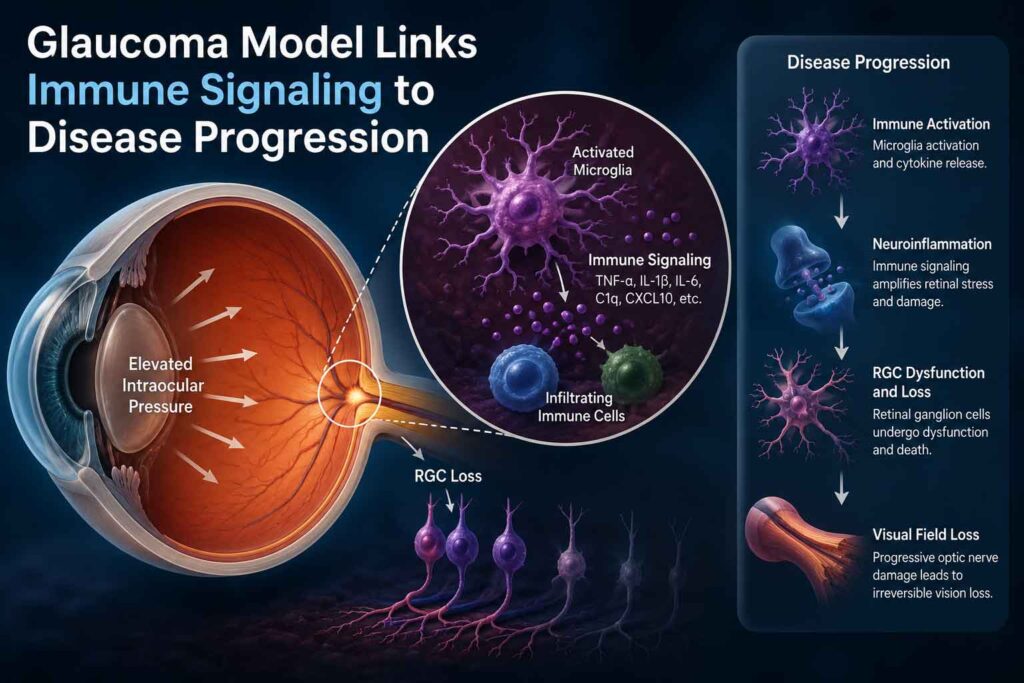
Researchers have developed an advanced model that maps the relationship between immune system activity and the progressive death of retinal ganglion cells (RGCs) — the neurons responsible for carrying visual information from the eye to the brain. The model demonstrates that glaucoma is not merely a mechanical problem caused by elevated eye pressure. Instead, it appears to be driven largely by a cascade of immune-mediated events that unfold over time.
At the core of these findings is the role of neuroinflammation. When IOP rises, it triggers a stress response in the optic nerve head, activating resident immune cells called microglia and astrocytes. These cells release pro-inflammatory cytokines and other signaling molecules that, over time, become damaging rather than protective. The model identifies specific immune pathways — including the complement system and tumor necrosis factor (TNF) signaling — as key drivers of RGC degeneration.
The Complement System: An Unexpected Culprit
One of the most important findings involves the complement cascade, a branch of the immune system typically associated with fighting infection. In healthy eyes, complement proteins help clear cellular debris. In glaucomatous eyes, however, these same proteins mistakenly tag healthy synapses and neurons for removal — a process known as synaptic pruning gone wrong.
This misdirected immune attack accelerates RGC loss even in patients whose intraocular pressure appears well-controlled. It helps explain a long-standing clinical mystery: why some glaucoma patients continue to lose vision despite successful pressure management. The answer, according to this model, lies in the autonomous progression of immune-driven damage.
TNF Signaling and Optic Nerve Damage
The model also highlights tumor necrosis factor-alpha (TNF-α) as a critical mediator of glaucoma progression. Elevated TNF-α levels have been detected in the aqueous humor and optic nerve tissue of glaucoma patients, and experimental studies show that blocking this pathway can significantly reduce RGC death. By incorporating TNF signaling into a unified disease model, researchers are now better equipped to understand how inflammation interacts with mechanical stress at the optic nerve head.
Implications for Glaucoma Treatment
These discoveries open an entirely new front in glaucoma therapy. Rather than relying solely on IOP-lowering eye drops or surgical interventions, future treatments may target the immune response directly. Several neuroprotective and anti-inflammatory approaches are already under investigation in clinical trials, including:
- Complement inhibitors designed to prevent misdirected synaptic removal
- TNF-α blockers adapted from rheumatology and oncology
- Microglial modulators that shift immune cells from a damaging to a protective state
This shift toward immunomodulatory therapy represents a paradigm change in glaucoma management — one that could benefit the millions of patients who continue to progress despite standard care.
Why Early Detection Matters More Than Ever
The immune signaling model underscores why early diagnosis is critical. The inflammatory cascade that drives RGC loss can begin long before noticeable vision changes occur. By the time a patient notices visual field defects, significant irreversible damage may already be present. Advanced imaging technologies, combined with biomarkers of immune activation, may soon allow clinicians to identify at-risk patients years earlier — enabling intervention before the immune response causes lasting harm.
Looking Ahead
The development of this glaucoma model linking immune signaling to disease progression marks a turning point in ophthalmic research. It bridges the gap between immunology and neurology, challenging long-held assumptions and pointing toward combination therapies that address both the mechanical and biological dimensions of the disease.
As researchers continue to refine this model and translate its findings into clinical practice, patients and clinicians alike can look forward to a new era of personalized, neuroprotective glaucoma care — one where preserving vision means not only reducing pressure, but also controlling the immune response that drives its loss.