# When Half Your Vision Goes Dark: It’s Not Your Eyes, It’s Your Nervous System
Imagine waking up one morning, opening your eyes, and realizing that the left half of your vision—in both eyes—has simply vanished. You blink, rub your eyes, and check for floaters or blurriness. But nothing is wrong with the eyeball itself. The world has been cut in half, as if someone drew a vertical curtain across your visual field. This is not a movie script. It is a real, terrifying medical event known as **homonymous hemianopia**, and the source of the problem lies not in your eyes, but deep within your brain’s wiring.
A recent case covered by Yahoo News highlights this exact scenario: a woman who lost half of her vision in an instant. She wasn’t having a stroke, a migraine, or a seizure in the traditional sense—at least not one she could feel. What she experienced is a classic symptom of a neurological crisis, often misdiagnosed or dismissed until it’s too late. If you or someone you know ever experiences this sudden, painless vision loss, understanding the nervous system’s role could save your sight—and your life.
## Why Your Eyes Are Not to Blame
When people hear “vision loss,” they instinctively point to the eyes. Cataracts, glaucoma, retinal detachment—these are ocular diseases. But when **half of your visual field goes dark in both eyes simultaneously**, the problem isn’t in the lens, the retina, or the optic nerve. It’s in the *optic tract* or *visual cortex* at the back of your brain.
Here’s the anatomy you need to know:
– Your left eye sees the left side of the world, and your right eye sees the right side—partially.
– The optic nerves from each eye meet at the **optic chiasm**, where fibers cross over.
– From there, the signals travel to the **occipital lobe** in the back of your brain.
– If a stroke, tumor, or vascular spasm damages the right side of your occipital lobe, you lose the left half of your vision in *both* eyes.
This is called **homonymous hemianopia**. It is a neurological symptom, not an ophthalmological one. The woman in the Yahoo News story likely experienced exactly this. Her eyes were healthy. Her brain’s visual processing center was under attack.
### The Silent Culprits Behind Sudden Vision Loss
The most common cause of homonymous hemianopia is a **stroke** affecting the posterior cerebral artery (PCA). But strokes are not the only trigger. Other possibilities include:
– Migraine with aura: Visual disturbances that typically resolve within 60 minutes. However, if the vision loss persists beyond an hour, it’s no longer a migraine—it’s an emergency.
– Seizure activity (occipital epilepsy): Electrical misfiring in the visual cortex can produce temporary blindness or colored hallucinations, then a period of vision loss afterward.
– Brain tumors or abscesses: Masses pressing on the optic pathways can cause gradual or sudden hemianopia.
– Vascular inflammation: Conditions like vasculitis or reversible cerebral vasoconstriction syndrome can restrict blood flow to the visual cortex.
In the specific case reported, the woman may have endured a **transient ischemic attack (TIA)** or a migraine variant that left her with a neurological deficit. The key takeaway: never assume that sudden, painless vision loss is a migraine if it involves a half-field defect in both eyes.
## The Red Flag Symptoms You Cannot Ignore
Not all vision loss is created equal. A grey curtain coming down over one eye typically signals a retinal artery occlusion or retinal detachment—an eye emergency. But when the loss is **hemianopic** (half of the visual field missing), and it affects both eyes equally, you need a neurologist, not an optometrist.
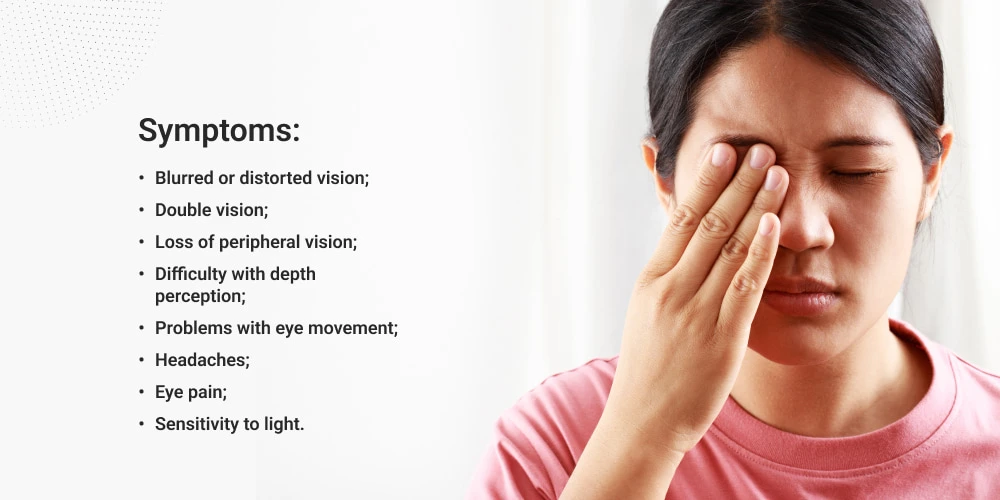
Watch for these specific signs:
–
–
–
–
–
If you experience any of these, do not wait. Do not take a nap. Do not assume it will pass. Call an ambulance or go to the emergency room immediately. **Time is brain tissue.**
## The Urgency: Why Every Minute Matters
When blood flow to the visual cortex is blocked, neurons begin to die within minutes. The window for effective treatment for an ischemic stroke is typically **4.5 hours** from symptom onset. After that, the damage may be permanent. In the case of the woman described in the news, she might have been lucky if the vision loss was temporary—but many are not.
What happens during those critical hours?
– Doctors can perform a CT or MRI scan to identify bleeding or blockage.
– They can administer **tissue plasminogen activator (tPA)** if it’s an ischemic stroke.
– They can check for seizures or migraines using EEG and other neurological tests.
If you arrive too late, the visual cortex may scar over, and that half of your world may never return. Even with rehabilitation, the brain’s plasticity is limited. Hemianopia that lasts more than a few days often becomes a permanent disability.
### A Neurological Emergency, Not an Eye Exam
I have seen patients sit in an optometrist’s waiting room for hours with a hemianopia, only to be told their eyes are fine and to “see a neurologist tomorrow.” Tomorrow is too late. The emergency room is equipped to handle neurological crises. The eye clinic is not.
The story from Yahoo News is a powerful reminder: when half your vision goes dark, your nervous system is screaming for help. Listen to it.
## What Recovery Looks Like
If treated quickly, some people regain full vision. Others are left with a permanent blind spot or reduced peripheral awareness. Recovery depends on:
–
–
–
For those with permanent hemianopia, rehabilitation options exist:
– **Visual scanning therapy**: Training to move the eyes and head more actively to compensate for the missing field.
– **Prism glasses**: Special lenses that shift images from the blind area into the seeing area.
– **Neuroplasticity exercises**: Computer-based programs that stimulate the undamaged parts of the visual cortex.
But none of these are a substitute for rapid emergency care. Prevention and early recognition remain the most powerful tools.
## A Final Neuro-ophthalmic Warning
The human visual system is a remarkable chain of cells, nerves, and blood vessels. When any link in that chain breaks, the result can be devastating. But we have a tendency to minimize symptoms that come and go. “It’s just a migraine.” “My eyes are tired.” “I’ll sleep it off.”
Half your vision going dark is not tired eyes. It is not a migraine variant unless it resolves completely within an hour and is followed by a headache. Any visual loss that lasts longer, that is painless, and that covers the same side of both eyes, is a **neurological 911**.
The next time you hear a story like the one from Yahoo News, remember: it wasn’t her eyes. It was her brain. And the faster she got to a neurologist, the better her chances of seeing the whole picture again.