UAE Becomes 3rd Country to Approve MIEBO for Dry Eye Treatment: A New Era for Ocular Health
The United Arab Emirates has once again positioned itself at the forefront of medical innovation. In a landmark decision that promises to transform the lives of millions suffering from chronic dry eye disease, the UAE has officially approved MIEBO, becoming only the third country in the world to do so. This groundbreaking treatment represents a paradigm shift in how we approach one of the most common yet undertreated ophthalmic conditions.
Understanding the Dry Eye Epidemic
Dry eye disease is far more than a temporary discomfort. For the estimated 344 million people worldwide living with this condition, the symptoms can be debilitating. Patients often describe a persistent sensation of sand or grit in their eyes, burning, stinging, redness, and fluctuating vision that interferes with reading, driving, and screen time.
What many don’t realize is that dry eye is a progressive inflammatory disease. When the ocular surface lacks adequate lubrication, it triggers a cascade of inflammatory responses that can damage the cornea and conjunctiva over time. This is not simply a matter of needing better eye drops—it’s a chronic condition requiring targeted therapeutic intervention.
In the UAE, the prevalence is particularly concerning due to environmental factors:
- Low humidity levels in desert climates accelerate tear evaporation
- Prolonged air conditioning exposure strips moisture from the eyes
- High screen usage reduces blink rates by up to 60%
- Contact lens wear is widespread among the younger population
What Makes MIEBO Different?
Traditional artificial tears provide temporary relief by supplementing the aqueous (water) layer of tears. But here’s the critical insight that many patients and even some clinicians miss: the majority of dry eye cases involve meibomian gland dysfunction (MGD). These tiny glands along the eyelid margins produce the oils that prevent tear evaporation. When they become blocked or dysfunctional, tears evaporate too quickly, leaving the ocular surface exposed.
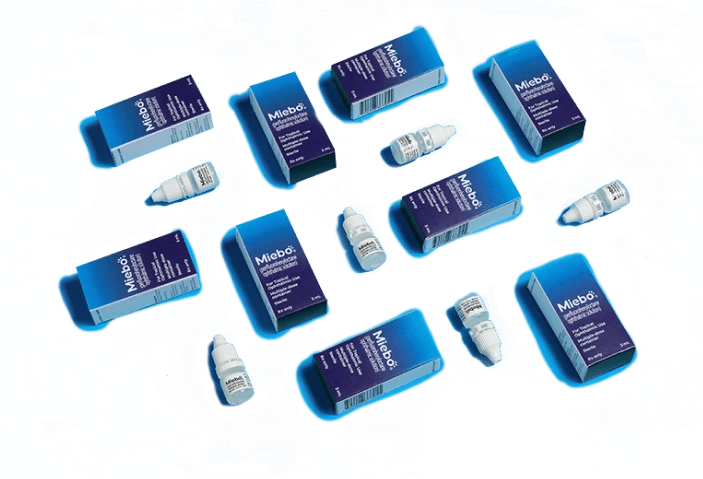
MIEBO (perfluorohexyloctane) is not an eye drop in the conventional sense. It is an innovative, preservative-free, water-free solution that works at the molecular level to restore the lipid layer of the tear film. Unlike artificial tears that merely add volume, MIEBO targets the root cause by:
- Stabilizing the tear film lipid layer to prevent evaporation
- Reducing friction between the eyelid and ocular surface
- Breaking the inflammatory cycle that perpetuates dry eye disease
- Providing sustained relief without the need for frequent reapplication
Clinical Evidence Supporting the Approval
The UAE’s regulatory approval is grounded in robust clinical data. Two pivotal Phase 3 trials, collectively known as the GOBI and MOJAVE studies, demonstrated MIEBO’s superiority over placebo in both signs and symptoms of dry eye disease.
Key efficacy endpoints included:
- Total corneal fluorescein staining (tCFS): MIEBO showed statistically significant improvement in corneal surface damage within just two weeks of treatment
- Eye dryness score: Patients reported a 30% greater reduction in dryness symptoms compared to control groups
- Sustained benefit: The therapeutic effect continued to improve over the 57-week study period, suggesting disease modification rather than temporary palliation
The safety profile was equally reassuring. The most common adverse events were mild instillation site reactions, such as transient blurring, which resolved quickly. There were no serious ocular adverse events attributed to the treatment.
Why the UAE’s Decision Matters Globally
The UAE follows only the United States and Canada in approving MIEBO. This rapid adoption signals several important trends in regional healthcare.
First, the UAE is emerging as a regulatory leader. The Ministry of Health and Prevention (MOHAP) has demonstrated a willingness to fast-track innovative therapies that address unmet medical needs. This positions the UAE as an attractive market for pharmaceutical companies launching novel treatments.
Second, it reflects the region’s specific disease burden. Ophthalmologists in the Gulf have long recognized that dry eye in this population is uniquely driven by evaporative causes. MIEBO’s mechanism directly addresses this pathophysiology.
Third, it creates access for patients who previously had limited options. While artificial tears, warm compresses, and lid hygiene remain first-line treatments, many patients fail to achieve adequate control. MIEBO offers a prescription-strength solution that can be layered onto existing regimens.
Clinical Implications for Practitioners
For ophthalmologists, optometrists, and primary care physicians managing dry eye patients, this approval changes the therapeutic landscape.
Patient selection is critical. MIEBO is indicated for evaporative dry eye due to meibomian gland dysfunction. It is not a replacement for aqueous-deficient dry eye treatments. However, given that MGD accounts for up to 86% of dry eye cases, the addressable patient population is substantial.
Realistic expectations matter. Unlike artificial tears that provide immediate but short-lived relief, MIEBO’s benefits build over weeks. Patients should be counseled that consistent twice-daily dosing is essential for optimal outcomes.
Integration with existing treatments is also important. MIEBO can be used alongside other dry eye therapies. It does not interact with topical medications like cyclosporine or lifitegrast, and it can complement in-office procedures such as IPL (intense pulsed light) or LipiFlow.
What Patients Should Know
If you suffer from chronic dry eye, this development brings genuine hope. Many patients have tried over-the-counter drops, gels, and prescription anti-inflammatories without finding lasting relief. MIEBO represents a fundamentally different approach.
Key patient takeaways:
- MIEBO is available by prescription only—you will need an eye exam to determine if you are a candidate
- It is applied twice daily, one drop in each eye
- The formulation is preservative-free, making it suitable for sensitive eyes
- Temporary blurring immediately after instillation is normal and resolves within minutes
- Most patients notice meaningful improvement within 4–8 weeks of consistent use
The Road Ahead
The UAE’s approval of MIEBO is likely to accelerate adoption across the Middle East and Asia. Saudi Arabia, Kuwait, and other Gulf nations with similar environmental challenges are expected to follow suit. Discussions are already underway in several European markets, though regulatory timelines vary.
Ongoing research continues to explore MIEBO’s potential in other applications. Preliminary studies suggest benefits in post-refractive surgery dry eye, contact lens intolerance, and certain ocular surface inflammatory conditions. The next generation of lipid-based therapies is also in development, building on the foundational science that MIEBO has established.
A Call to Action for Eye Care Providers
This is not the time for passive observation. Ophthalmology practices across the UAE should prepare for increased patient inquiries. Educational materials, staff training on MIEBO’s mechanism, and clear treatment protocols will be essential.
Consider implementing a dry eye staging system that identifies MGD-predominant patients who would benefit most. Simple in-office tests—meibomian gland expression, tear break-up time, and lipid layer thickness assessment—can guide appropriate prescribing.
The dry eye treatment paradigm is evolving. We are moving away from a one-size-fits-all approach of artificial tears and toward targeted, evidence-based therapies that address the underlying pathology. MIEBO is not merely a new product; it is a proof of concept that lipid-based therapy works.
Final Thoughts
The UAE’s decision to become the third country globally to approve MIEBO underscores its commitment to delivering cutting-edge healthcare to its residents. For the millions struggling with the daily burden of dry eye, this approval is more than a regulatory milestone—it is a lifeline.
Dry eye disease affects quality of life in ways that are often underestimated. The constant irritation, fluctuating vision, and daily discomfort can significantly impact both personal and professional life. With effective treatments now available, these outcomes are increasingly preventable.
MIEBO represents a shift toward more targeted ocular therapy. As with any new treatment, appropriate patient selection and proper expectations will be key to success. However, the clinical evidence is strong, and the need is clear.
For patients, the message is simple: consult your eye care professional to see if MIEBO is appropriate for you. For practitioners, the message is equally direct: treatment protocols are evolving, and staying updated is essential.