A Young Hunter’s Dream: Bagging a Gobbler with a Rare Eye Disease
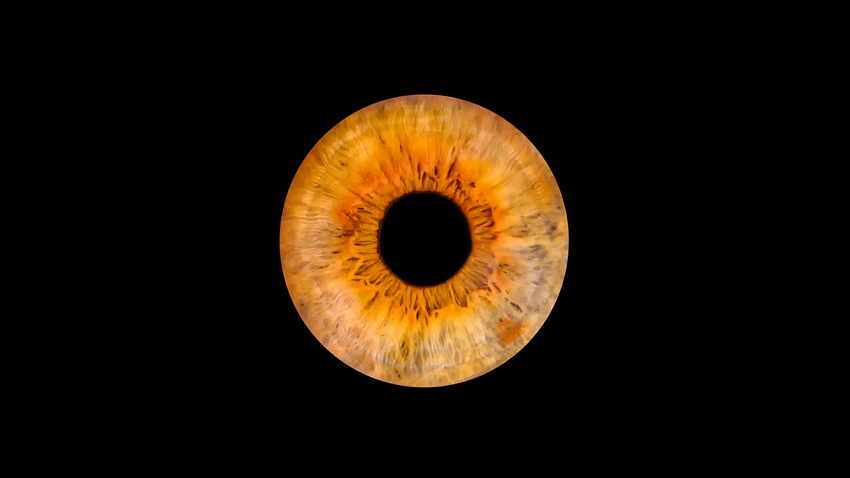
The crisp morning air of Pennsylvania’s turkey woods holds a unique magic, a blend of anticipation, patience, and raw connection to nature. For most hunters, the challenge lies in outsmarting one of the wariest game birds in North America. But for 14-year-old Hunter Miller, the challenge began long before he ever stepped into the forest. Hunter was born with ocular albinism, a rare genetic condition that severely limits his vision and creates extreme sensitivity to light. Yet, with an unwavering spirit and a supportive community, he recently achieved a milestone that redefines the meaning of a successful hunt: harvesting his first gobbler.
Seeing the World Differently, Aiming for the Same Goal
Ocular albinism affects the eyes, often resulting in reduced visual acuity, nystagmus (involuntary eye movements), and photophobia. For Hunter, the world is a blurry landscape where details are hard to discern. Bright sunlight—a staple of spring turkey season—is physically painful. The idea of spotting a distant tom, tracking its movement through dense underbrush, and making a precise shot seems, to many, an insurmountable hurdle.
But Hunter Miller is not defined by his diagnosis. He is defined by his name, his passion, and his family’s dedication. His father, Josh Miller, recognized early on that his son’s love for the outdoors shouldn’t be dimmed by a visual impairment. They adapted. They persevered. Hunting became less about perfect vision and more about enhanced senses, trust, and technique.
The Adaptive Tools of the Trade
Preparing for the hunt meant thinking outside the box. Standard equipment wouldn’t suffice. Hunter and his family employed adaptive strategies that leveled the playing field:
- Audio Over Optics: While most hunters rely heavily on their eyes, Hunter’s world is defined by sound. He became adept at using a box call, learning to mimic the exact yelps, clucks, and purrs of a hen turkey with remarkable skill. His hearing, sharpened by necessity, became his primary tool for locating and communicating with gobblers.
- Close-Quarter Strategies: Instead of attempting long-range spotting, the plan focused on setting up in areas with predictable turkey movement and calling them in close. The goal was to get the bird within a range where Hunter could confidently identify and make an ethical shot.
- Trust as a Foundation: This hunt was a true partnership. His father acted as his guide, not by taking the shot for him, but by helping with navigation, describing the terrain and animal movement in detail, and ensuring safety. Their communication was silent, built on years of shared experience and mutual trust.
The Morning of a Lifetime
On that fateful morning, the duo set out in the dark. As dawn broke, Hunter’s world began as a haze of painful light and vague shapes. But then, the woods came alive with sound. A gobbler sounded off in the distance, answering Hunter’s expert calls. The chase was on.
Through a series of careful moves and patient calling, Hunter and his dad worked the bird closer. The tom was interested, but wary, strutting just out of clear visual range. Then, a breakthrough. Using the terrain to their advantage, they positioned themselves for a closer encounter.
A Shot Through Adversity
As the tom closed the distance, Hunter’s father helped him get into position. He described the scene: the fan, the beard, the bird’s orientation. Hunter shouldered his shotgun, not seeing a clear picture as a sighted hunter would, but focusing on the blur of color and movement his father described. He trusted his training, his instincts, and his team. With a deep breath, he squeezed the trigger.
The shot rang true. In that moment, the blurry world focused into a singular achievement. The young hunter with the fitting name had done it. He had harvested a beautiful gobbler, a testament not to perfect vision, but to perfect determination.
More Than a Turkey: The Impact of an Inclusive Outdoors
Hunter Miller’s story transcends a single hunting success. It is a powerful narrative about inclusivity in the outdoors. It challenges preconceived notions about who can be a hunter and what abilities are required. His journey highlights several crucial points:
- Adaptive Hunting is Real Hunting: Success in the field isn’t solely dependent on 20/20 vision. It hinges on knowledge, woodsmanship, patience, and heart—qualities Hunter has in abundance.
- The Role of Mentors and Community: The supportive framework provided by Hunter’s family, and by extension, the wider hunting community, is essential. Organizations that promote adaptive hunting are vital in opening doors for others facing similar challenges.
- Redefining the Trophy: For Hunter, the true trophy isn’t just the gobbler’s beard or spurs. It’s the memory of the morning, the bond with his father, and the profound personal victory over adversity. It’s the proof that his dream was valid and attainable.
A Beacon of Inspiration
Hunter’s story, originally shared by LancasterFarming.com, has resonated far beyond the Pennsylvania woods. It serves as a beacon for other young people with disabilities, showing them that their outdoor dreams are valid. It also reminds seasoned hunters of the core values of the tradition: resilience, respect for the game, and passing on the heritage.
For Hunter Miller, the future is bright, even if his vision isn’t. He has proven that with the right support and an indomitable will, barriers can be broken. His first gobbler is more than a bird; it’s a symbol of possibility, a feathered testament to the fact that some of the best hunters don’t just see the woods—they feel them, hear them, and understand them on a deeper level. His dream, once a blurry hope, is now a clear and inspiring reality.