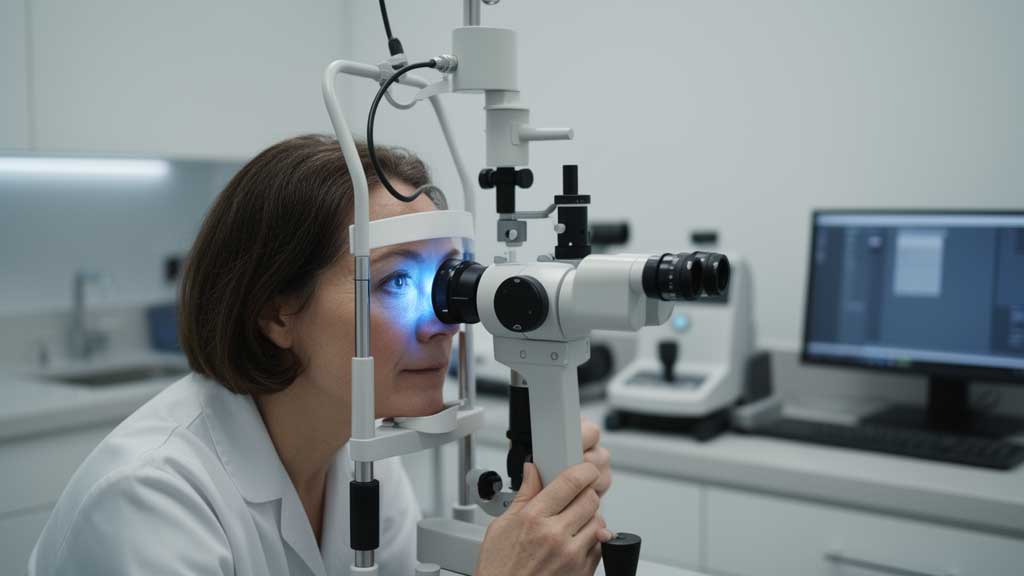
Citicoline for Glaucoma: Why Eye Pressure Isn’t the Whole Story
Imagine you’ve followed your eye doctor’s plan for years. You use your drops every night and your eye pressure looks fine at every visit. Yet your visual field tests keep showing small losses.
This happens to some people with glaucoma, and it is one reason researchers keep looking for treatments beyond pressure control. Citicoline, a supplement studied as a possible neuroprotectant, is one of the candidates. A new study adds data to that conversation, with some important caveats.
What the Researchers Did
The study, led by Menna and colleagues and published in 2026 in Frontiers in Neuroscience, was a prospective, non-randomized, open-label cohort study. It followed patients with progressing primary open-angle glaucoma or normal-tension glaucoma. All of them were already on stable topical therapy.
The team offered oral citicoline as an add-on, taken twice daily. They enrolled 80 patients in total, 40 patients (40 eyes) in the citicoline group and 40 patients (40 eyes) in the control group. Everyone completed the 12-month follow-up.
The control group was made up of patients who declined citicoline because of cost. This matters, and we’ll come back to it below.
How They Measured Results
The main outcome was mean sensitivity on MP-3 microperimetry, a test that maps how well the central retina responds to light. Secondary measures included fixation stability, visual field mean defect, and retinal nerve fiber layer (RNFL) and ganglion cell complex (GCC) thickness. The team also measured macular and peripapillary vessel density using optical coherence tomography angiography.
Together, these tests cover function, structure, and blood vessel density. That is a broader picture than many earlier citicoline trials, which leaned mostly on perimetry and electrophysiology.
What the Numbers Showed
Mean sensitivity on MP-3 microperimetry changed by +1.7 dB in the citicoline group, compared with -0.4 dB in the control group. The difference stayed significant after adjusting for time (treatment-by-time p less than 0.001).
Intraocular pressure did not differ between the two groups at 12 months (p = 0.30), and there was no significant treatment-by-time interaction for pressure (p = 0.68). So the retinal sensitivity difference was not explained by changes in eye pressure.
Fixation stability, measured by BCEA and P1, improved only in the citicoline group (p = 0.03 and p = 0.02). Fixation stability reflects how steadily the eye holds on a target, which relates to central vision.
A post hoc responder analysis defined responders as patients with a confirmed gain of at least 1.5 dB in sensitivity and no visual field progression. Responders made up 65.0% of the citicoline group versus 22.5% of the control group.
For safety, adverse events were mild and transient, and they occurred in 12.5% of the citicoline group. No serious adverse events were reported.
Structural and Vessel Findings: Read These Carefully
The secondary results leaned in the same direction, but they are weaker. Visual field mean defect worsened by 0.30 dB per year in the citicoline group versus 0.82 dB per year in controls (p = 0.01).
RNFL thickness decreased by 0.55 μm per year with citicoline versus 1.18 μm per year in controls (p = 0.01). GCC thickness decreased by 0.42 μm per year versus 0.96 μm per year (p = 0.02). Macular and peripapillary vessel density dropped less in the citicoline group (p = 0.04 and p = 0.03).
The authors pointed out that none of these secondary differences would hold up after correction for multiple testing. They also noted the differences fell within the range of test-retest variability, which limits their clinical meaning.
Limits You Should Know About
The authors state that these findings describe an association, not proof that citicoline works. Several design issues explain why.
First, patients chose their own group, so assignment was not random. Second, the study was open-label, meaning both patients and investigators knew who was taking citicoline, which can introduce bias.
Third, the control group declined treatment because of cost. Those patients may differ from the citicoline group in motivation, health status, or other ways that were not measured. The authors say randomized, placebo-controlled trials are needed to confirm any neuroprotective effect.
Also note that this study looked at patients with progressing open-angle or normal-tension glaucoma on stable topical therapy. The results should not be assumed to apply to every type or stage of glaucoma.
When to See a Doctor
Glaucoma often causes no pain and no early symptoms, so regular eye exams matter. Doctors typically check eye pressure with tonometry, look at the optic nerve, and use visual field testing and OCT imaging to track changes over time.
See an eye doctor if you notice patchy or narrowing side vision, trouble adjusting in dim light, or changes in central vision. People with a family history of glaucoma, older adults, and those with other known risk factors should keep up with scheduled checkups.
Seek urgent care right away if you have sudden eye pain, a red eye with blurred vision, halos around lights, headache with nausea, or a sudden loss of vision. These can signal an acute problem that needs prompt treatment.
Your Next Step
Do not start, stop, or replace any glaucoma treatment based on one observational study. Citicoline has not been shown to replace pressure-lowering care, which remains the proven approach.
If you are curious about citicoline for glaucoma, bring this research to your next appointment and ask your ophthalmologist whether it is appropriate for your situation. Ask, too, how often your visual fields and OCT scans should be repeated so any change is caught early. Keep using your prescribed drops as directed and keep your follow-up visits.