Why Systolic Blood Pressure Matters in Glaucoma Progression
Glaucoma can gradually damage vision without causing noticeable symptoms during its early stages. Someone may continue with everyday activities while losing parts of their visual field, making regular eye examinations essential for detecting changes before substantial vision impairment develops.
Although eye pressure has traditionally been a major focus of glaucoma management, new research suggests that fluctuations in blood pressure may also influence how quickly the disease progresses.
A prospective study published in the journal Eye and Vision in 2026 found that greater long-term variability in systolic blood pressure was independently associated with faster visual field deterioration among people diagnosed with primary open-angle glaucoma.
The findings suggest that monitoring cardiovascular health could provide additional information when evaluating glaucoma progression. However, the research does not establish that blood pressure fluctuations directly cause vision loss.
What the 2026 Glaucoma Research Discovered
The research, titled Relationship between long-term blood pressure fluctuations and visual field progression in primary open-angle glaucoma: a prospective cohort study, examined the relationship between changes in blood pressure and declining visual function.
The investigators analyzed 157 eyes from 157 individual patients diagnosed with primary open-angle glaucoma. Participants were enrolled in the Wenzhou Glaucoma Progression Study between August 2014 and April 2024.
The average age at the beginning of the study was 56.3 years. Researchers followed participants for an average of 6.1 years, with approximately 16.9 clinical visits per person.
During the observation period, 71 eyes, representing 45% of the study group, demonstrated confirmed visual field progression.
The researchers also reported that 40.8% of participants had a documented history of systemic arterial hypertension, while 22.9% had diabetes mellitus. Participants with these conditions were receiving systemic medical management.
These findings are important because they suggest that changes in blood pressure over time may provide additional information about glaucoma progression beyond measurements taken during individual eye examinations.
How Blood Pressure Fluctuations May Affect Vision
Systolic blood pressure refers to the pressure exerted against artery walls when the heart contracts and pumps blood. It is the upper number in a standard blood pressure reading.
For example, in a reading of 120/80 mmHg, the systolic measurement is 120 mmHg, while the diastolic measurement is 80 mmHg.
Blood pressure naturally changes throughout the day because of physical activity, stress, sleep, medications, and other physiological factors. However, researchers are increasingly interested in whether substantial changes between clinical visits could affect the small blood vessels supplying the optic nerve.
The optic nerve carries visual information from the retina to the brain. In glaucoma, damage to the retinal ganglion cells and their nerve fibers gradually reduces visual function, often beginning with peripheral vision.
The researchers proposed that repeated systolic pressure fluctuations could interfere with the body’s ability to regulate blood circulation around the optic nerve head. Possible mechanisms include impaired endothelial function, altered nitric oxide pathways, and increased arterial stiffness.
These mechanisms remain potential explanations rather than proven causes. Nevertheless, they provide a biological reason to investigate cardiovascular factors alongside traditional glaucoma measurements.
Important Study Results: Progression Rates and Risk Factors
One of the most notable findings involved the difference in visual field deterioration between patients whose glaucoma progressed and those whose condition remained stable.
Across the entire study group, the average rate of visual field mean deviation decline was -0.29 decibels per year.
When researchers separated the participants into groups, they observed substantially different rates:
Patients with confirmed progression: -0.53 decibels per year.
Patients with stable visual fields: -0.09 decibels per year.
The researchers also identified two independent risk factors associated with visual field progression in their multivariable Cox regression analysis.
Optic disc haemorrhage was associated with a hazard ratio of 2.60, while each unit increase in systolic blood pressure variability was associated with a hazard ratio of 1.12.
Another important result involved the relationship between systolic variability and the speed of visual deterioration. Each one-percentage-point increase in systolic blood pressure variability was associated with an additional decline of -0.127 decibels per year in visual field mean deviation.
Interestingly, diastolic blood pressure variability did not demonstrate comparable predictive significance. Intraocular pressure variability also showed no statistically significant association with the rate of visual field decline in the longitudinal analysis.
These findings do not mean that eye pressure is unimportant. Rather, they suggest that systolic blood pressure variability may represent an additional factor worth considering when assessing patients with primary open-angle glaucoma.
How Researchers Monitored Eye Pressure and Blood Pressure
The study used repeated clinical measurements to examine changes over several years instead of relying on a single blood pressure reading.
Participants needed at least two years of follow-up and a minimum of five reliable visual field examinations. Standard automated perimetry was conducted every three to six months using a Humphrey Field Analyser 750i and its central 24-2 testing program.
Glaucoma progression was evaluated using Early Manifest Glaucoma Trial criteria. Researchers considered progression confirmed when sensitivity deteriorated significantly at three or more identical visual field locations across three consecutive reliable examinations.
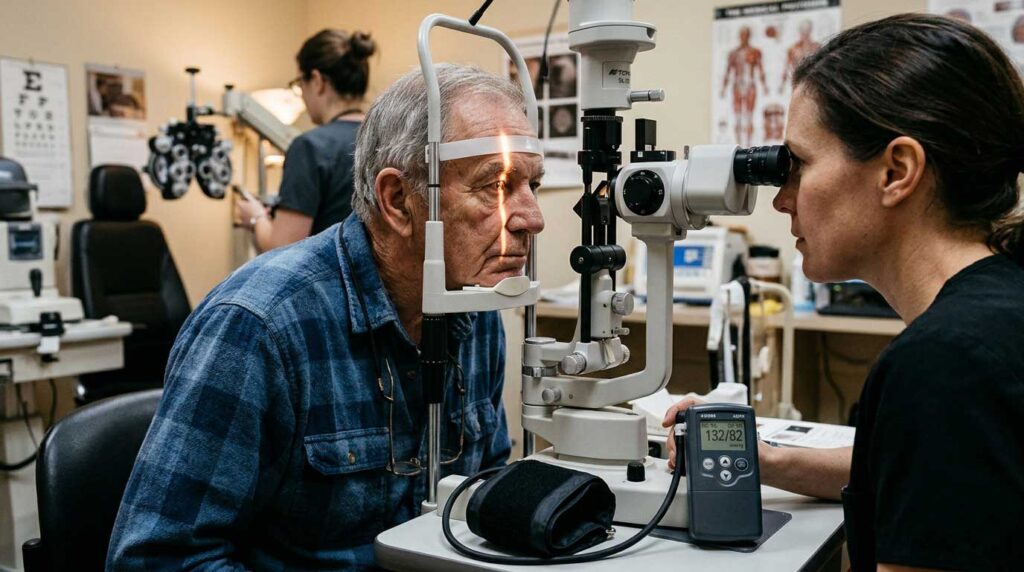
Eye pressure was measured using Goldmann applanation tonometry. This is a commonly used clinical procedure that estimates intraocular pressure by measuring the force needed to flatten a small area of the cornea.
Blood pressure measurements were taken during daytime clinical visits between 8:00 a.m. and 5:00 p.m. Participants rested quietly for at least five minutes before two consecutive seated readings were obtained from both arms using a validated upper-arm digital monitor.
To distinguish blood pressure instability from consistently high or low readings, investigators calculated the coefficient of variation. This measurement uses the standard deviation divided by the mean, multiplied by 100 percent.
By examining repeated measurements, the research team could investigate whether variability itself was associated with visual deterioration rather than simply looking at average blood pressure levels.
What Glaucoma Patients Should Know and When to See an Eye Doctor
Although the findings provide useful information, patients should understand the limitations of the research. The study involved a single-center cohort of relatively young Chinese patients with early-to-moderate visual field defects at baseline.
Blood pressure was measured during scheduled daytime visits rather than through continuous ambulatory monitoring. The investigators also acknowledged that the effects of specific systemic and topical blood pressure medications were not fully measured.
Consequently, the results should not be interpreted as proof that every person with unstable blood pressure will experience glaucoma progression. They also do not establish that deliberately changing blood pressure will prevent optic nerve damage.
People diagnosed with glaucoma should continue attending scheduled ophthalmology appointments. Eye examinations may include visual field testing, tonometry, optic nerve assessment, and gonioscopy, which examines the drainage angle inside the eye.
Patients should also discuss significant blood pressure changes with their healthcare providers. They should not stop, reduce, or change prescribed blood pressure medication without medical guidance.
When should you see an eye doctor?
Arrange an eye examination if you notice gradually worsening peripheral vision, difficulty seeing objects at the sides of your visual field, or changes in your ability to navigate familiar surroundings.
Sudden vision loss, severe eye pain, a red eye, or blurred vision accompanied by nausea requires urgent medical assessment. These symptoms should not be assumed to be ordinary glaucoma progression.
Can blood pressure fluctuations cause glaucoma?
The study found an association between greater systolic blood pressure variability and faster visual field deterioration in people who already had primary open-angle glaucoma. It did not establish that blood pressure fluctuations cause glaucoma to develop.
Should glaucoma patients monitor their blood pressure?
Discuss blood pressure monitoring with your ophthalmologist and primary healthcare provider, particularly if you have hypertension or other cardiovascular conditions. Consistent measurements can help your healthcare team understand changes in your overall health.
The 2026 findings add another dimension to glaucoma research by highlighting the possible relationship between cardiovascular stability and long-term visual function. If you have glaucoma, consider discussing both your eye examination results and blood pressure history at your next appointment so your healthcare providers can evaluate your overall risk factors.